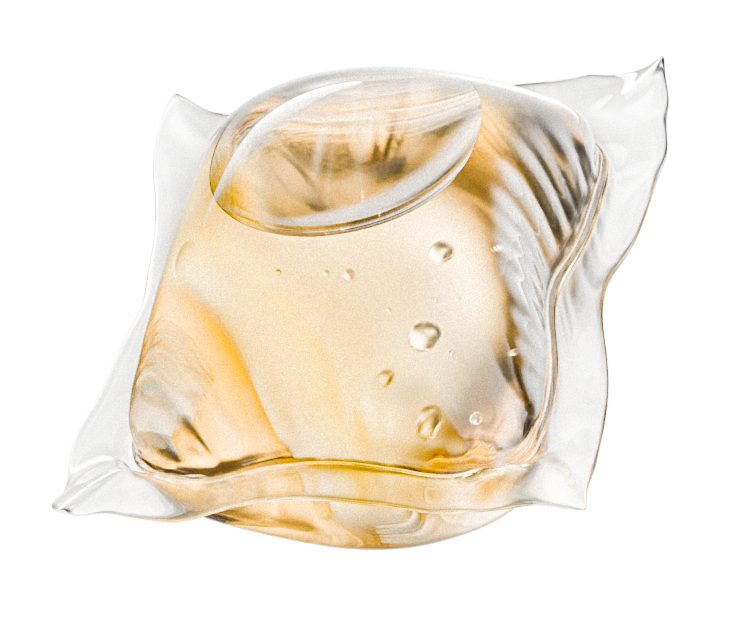
Yes, our pods have a film. No, it doesn't make microplastics.
You've seen the claims. We get it — a pod looks like a plastic wrapper, and the word "polymer" doesn't exactly calm nerves. So let's get the facts about what pod film is, what it isn't, and what actually happens to it in your wash.
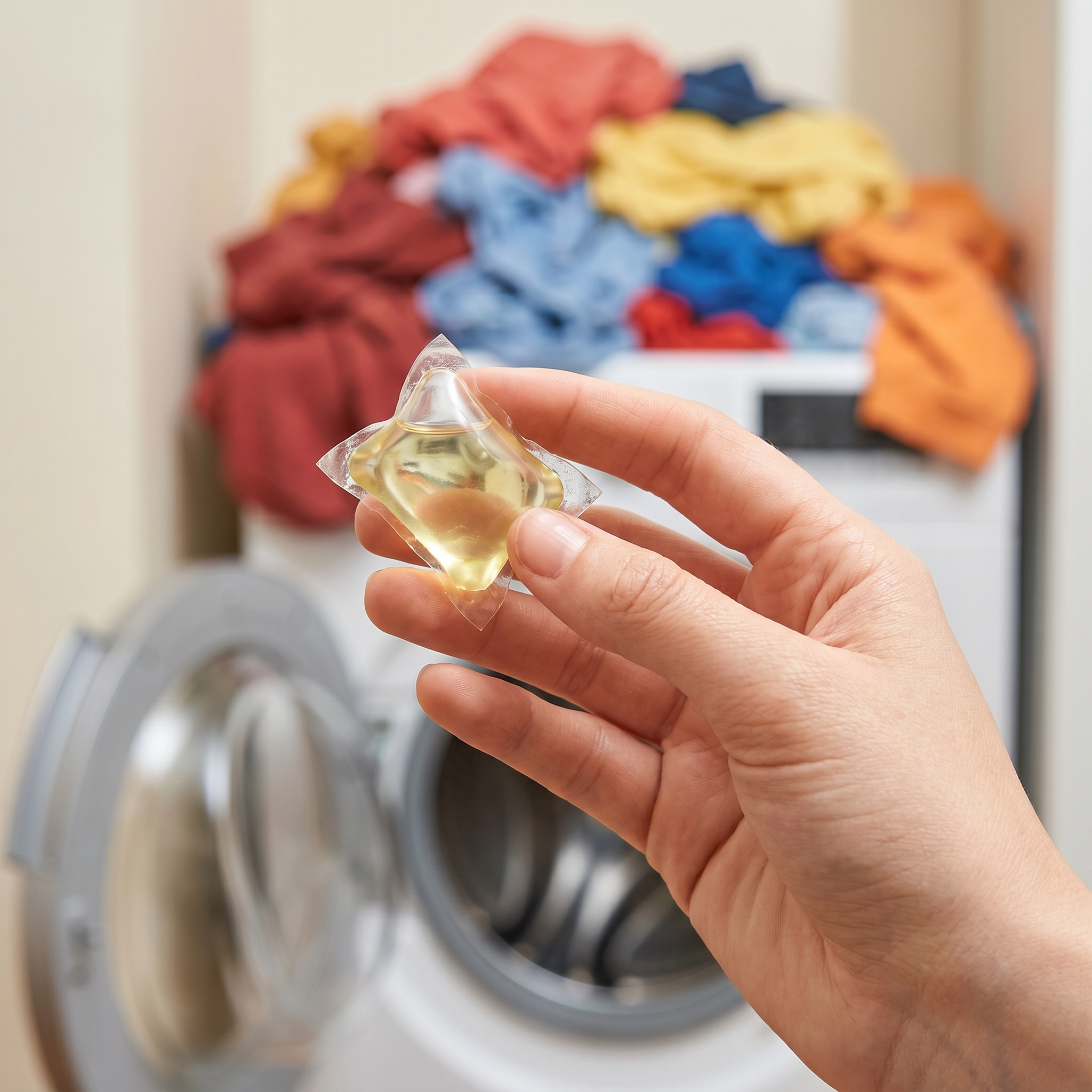
The weight of independent peer-reviewed research* supports PVOH's safety. We’ve put everything on the table - you decide.
What exactly is PVOH?
-
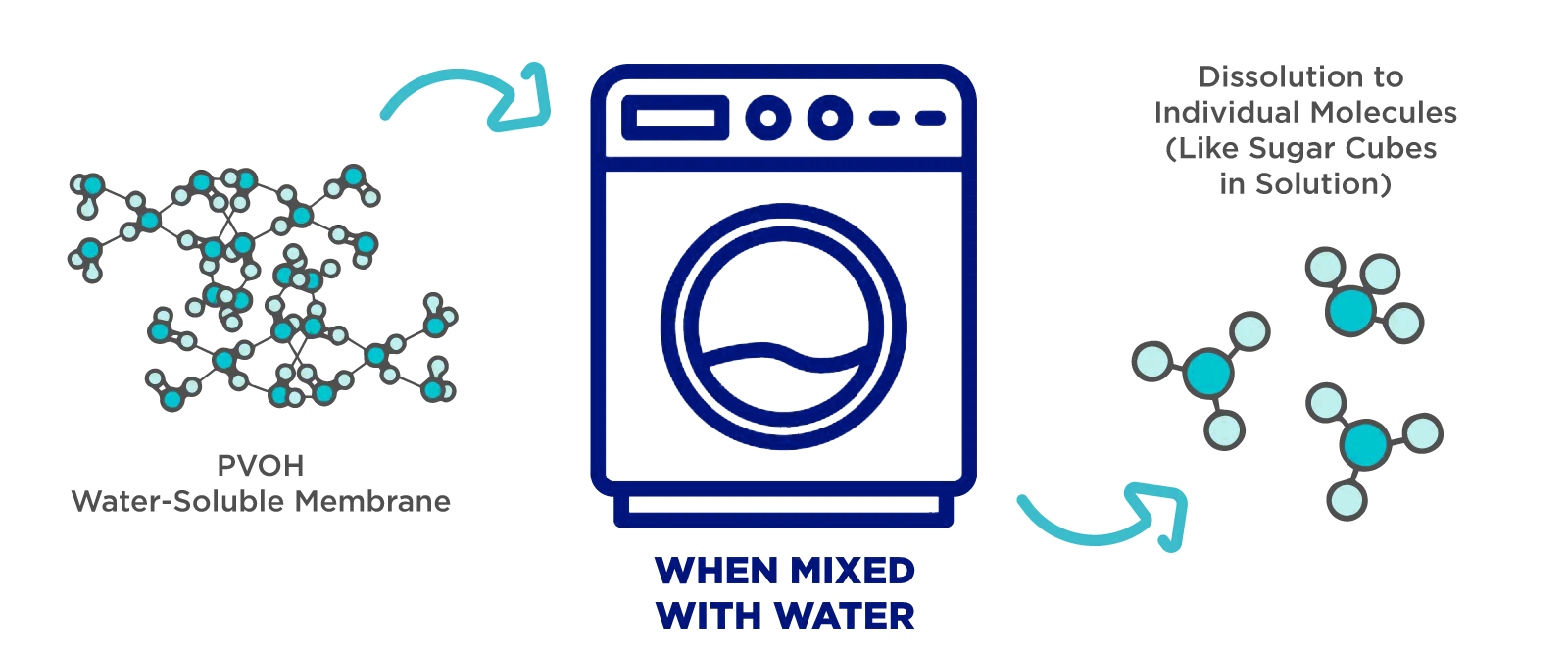
Polyvinyl alcohol (PVOH, also written PVA) is a water-soluble synthetic polymer made of just three atoms: Carbon, Hydrogen, Oxygen.
-
That's the complete list: just the same three atoms found in table sugar.
-
Not all PVOH behaves the same way — and this distinction is central to understanding why it's safe in your laundry pod.
Not all PVOH is the same - some breaks down, some doesn’t.
97% OF ALL PVOH
Water-resistant
Rigid, hard to dissolve. Used in industrial adhesives, paper coatings, textile sizings. Not what we use.
THINK: GLUE OR FISHING NETS
★ OUR PODS
<3% OF ALL PVOH
Highly Water Soluble
Dissolves readily in water. Used in laundry and dishwasher pods, laundry sheets, pharmaceutical capsules, eye drops, and breath strips.
SETTING THE RECORD STRAIGHT
From pod to drain to gone.
①
Pod meets water
The PVOH film contacts water and begins to dissolve immediately — not break apart. From solid to solution.
②
Full dissolution
The film becomes individual polymer chains in solution — like sugar dissolving in water.
③
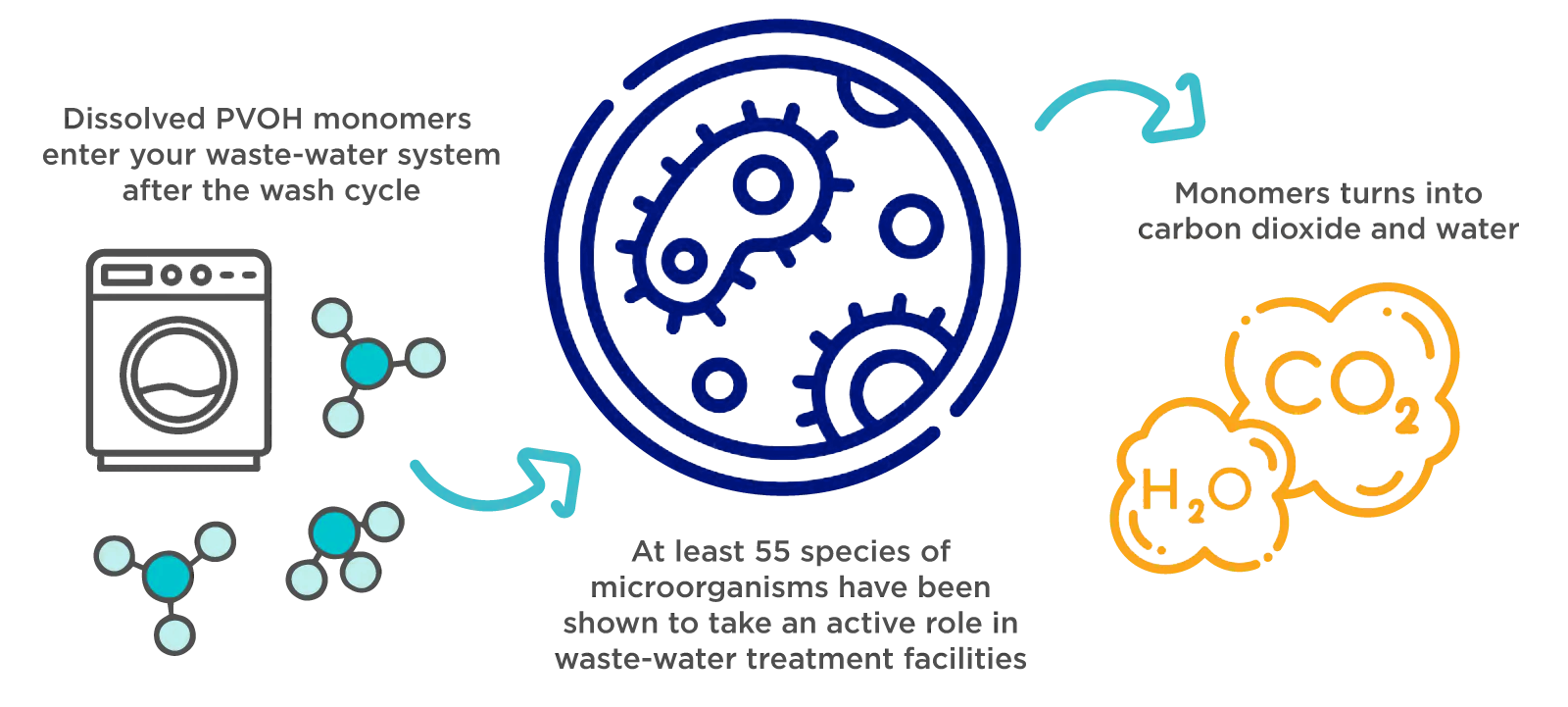
Down the drain
Dissolved PVOH chains travel with the wash water into the municipal wastewater system.
④
Biodegradation
Dozens of species of bacteria, yeasts, and fungi in standard wastewater treatment plants consume PVOH as a carbon source.
⑤
CO₂ + water
The microorganisms break the PVOH chains down completely into carbon dioxide and water. Nothing persistent remains.
Source: Chiellini et al., Progress in Polymer Science, 2003 (reviewing 190+ peer-reviewed papers); Byrne et al., De Gruyter, 2021; OECD 301 test results on Dropps pod film.
You've trusted this ingredient your whole life. You just never knew its name.
The water-soluble film around a Dropps pod uses the same category of material — FDA-recognized PVOH — found across an enormous range of everyday consumer, personal care, and medical products.
Dropps Laundry Pods
Pod Film
Dropps Dish Pods
Pod Film
Contact lens solution
Viscosity enhancer
Vitamin capsules
Edible film - FDA GRAS
Laundry sheets
Detergent sheet carrier
Breath freshener
Orally dissolvable film
THE SCIENCE EXPLAINED
Independent parties who have reviewed PVOH and found it safe

U.S. EPA Safer Choice
Green circle (preferred status). Upheld after formal petition challenge, April 2023.
FDA — GRAS status.
Generally Recognized As Safe for oral and ophthalmic use (GRN 000122).
EPA CleanGredients
Listed on the definitive database of EPA Safer Choice–approved cleaning ingredients.
EU REACH (2023)
PVOH film explicitly exempted from EU synthetic microparticle restrictions (Reg. EU 2023/2055).
50+ independent peer-reviewed papers* say the same thing.
A significant body of work supports PVOH biodegradation through natural microbial mechanisms. Here are the key studies cited by the EPA in its own review.
Meier, Stetler, Lee et al. — Environmental Safety Assessment of a New Detergent Raw Material.
SOFW Journal · March 2013
American Dyestuff Reporter · 1997
ACI — EPA Maintains Safer Choice Status of Essential Chemistry Used to Make Detergents.
American Cleaning Institute · April 2023
Polymers for Advanced Technologies · 2000
Agricultural and Biological Chemistry · 1973
We think honesty is the best ingredient policy.
We use PVOH because the weight of independent science and regulatory oversight supports its safety. Not because it's perfect, and not because the conversation is over.
The real microplastic crisis is real — and it comes from synthetic clothing fibers, tire wear particles, and conventional plastic packaging. Those sources aren't in dispute. Conflating water-soluble, biodegradable pod film with persistent plastic pollution doesn't help solve it.
We'll keep watching the science. If the evidence changes, our formulas will change with it. In the meantime, you have the full picture — and every source we've cited is linked above so you can check it yourself.
FREQUENTLY ASKED QUESTIONS
Still have questions? Good.
-
It depends what you mean by 'plastic.' The film around our pods is made from PVOH (polyvinyl alcohol), a synthetic polymer — and technically, polymers are the chemical family that includes plastics. But the word 'plastic' in everyday use typically means something persistent: a bag, a bottle, something that sticks around in the environment. PVOH doesn't behave that way. It dissolves completely in water, doesn't fragment into large solid particles, and biodegrades in wastewater treatment. Calling it 'plastic' in the pollution sense misrepresents what it actually is and does.
-
No. Microplastics are defined as solid, insoluble plastic particles — under California's definition, solid polymeric materials between 1 and 5,000 µm. PVOH dissolves completely in water into individual polymer chains in solution, the same way sugar dissolves. It doesn't fragment into solid microplastic particles. It is not detected as a microplastic polymer in environmental monitoring studies. The EPA reviewed a formal challenge to this exact claim in 2023 and found the evidence insufficient to warrant a change in PVOH's safety status.
-
Yes — specifically, detergent-grade PVOH passes OECD 301 ready biodegradability testing, the standard used by regulators worldwide. After dissolving in your wash, the PVOH polymer chains are consumed by microorganisms found naturally in wastewater treatment plants, breaking down completely into CO₂ and water. This has been confirmed by 50+ independent peer-reviewed studies over more than five decades of research.
-
Just three atoms: carbon, hydrogen, and oxygen — the same building blocks found in table sugar. PVOH starts as vinyl acetate, which is polymerized into polyvinyl acetate (white school glue), then reacted with water through hydrolysis to produce polyvinyl alcohol. Dropps uses the PVOH we choose specifically because it dissolves completely in water.
-
Usually not. Most laundry sheets use PVOH as their primary structural material - it’s what holds the sheet together and allows it to dissolve. Unlike a pod where PVOH is a thin outer film representing a small fraction of the total product weight, PVOH can make up to 30-50% of a laundry sheet’s total weight.